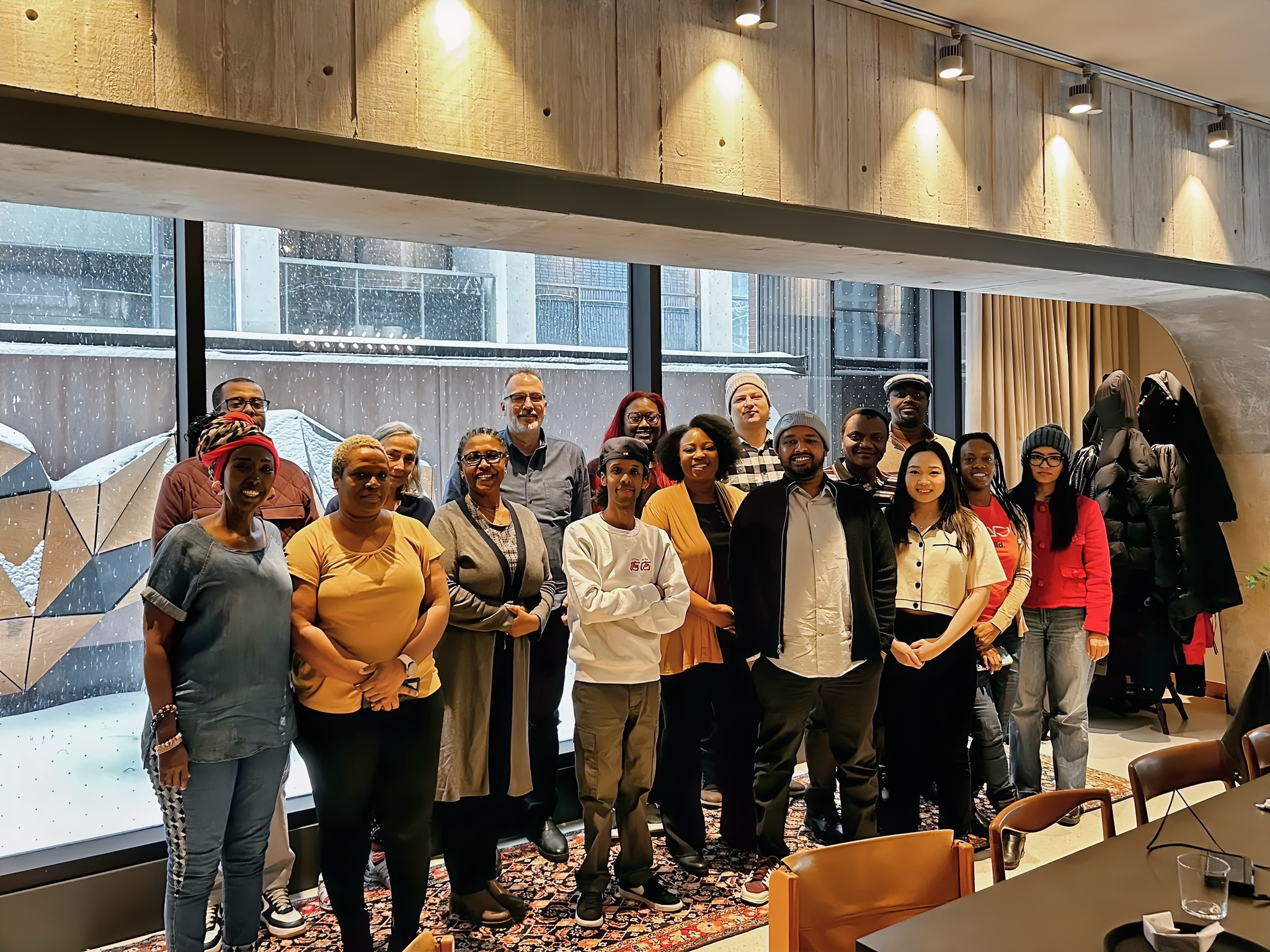
During our 10th-anniversary celebration, we were honored to host Julian Gross, who provided invaluable insights on community benefits agreements in land use and infrastructure. Julian is a lawyer and principal expert on community benefits in land use development and public infrastructure who has negotiated dozens of community benefits agreements, project labour agreements and community workforce agreements in cities across North America.
His visit enriched our strategies and reinforced our commitment to advancing equitable development and community benefits agreements in Toronto. Julian's expertise will guide us as we continue to build community power and mobilize for community benefits.
 |
 |
Julian Gross's visit during our 10th-anniversary celebration provided invaluable insights on community benefits agreements in land use and infrastructure. Julian's expertise will guide us as we continue to build community power and mobilize for community benefits in neighbourhoods across Toronto
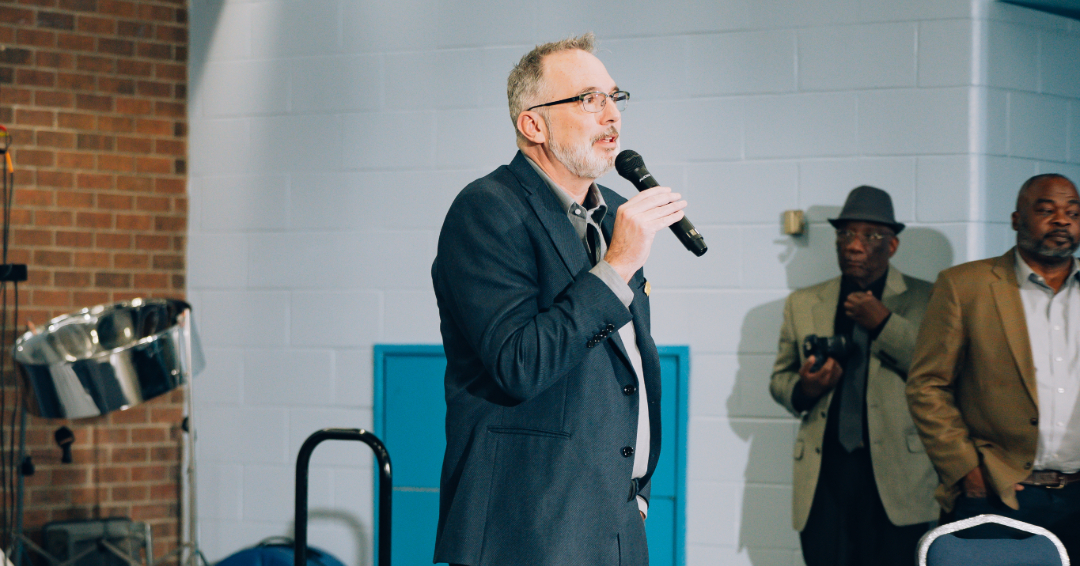
JULIAN GROSS BLOG POSTCommunity Benefits in Land Use and Infrastructure: Concepts, Tools, and Strategies |
Principal, Law Office of Julian Gross
Many of you attended TCBN’s Tenth Anniversary Celebration in March 2024. I was lucky to be able to travel from California to participate in this wonderful event, and help celebrate TCBN’s first decade of successful advocacy to advance community benefits and racial equity in the region.
In the wake of my trip, TCBN asked me to provide the Network with concepts and best practices on community benefits in land use development and infrastructure construction. I’m happy to do so, and hope this high-level framework will be helpful to the Network’s continued advocacy.
When thinking about the range of community benefits strategies, it’s helpful to separate land use development from infrastructure construction. While these categories have some overlapping dynamics and policy goals, they require different tools and advocacy approaches.
Land Use Development. In discussing land use development, the classic forum for advancing community benefits is negotiation of mega-projects: large land use development project being advanced by a private developer, but needing extensive public support.
Public support may take the form of land sales, leases, financial assistance, tax credits, supportive infrastructure construction, and so forth. Government can negotiate community benefits with a private developer in any situation where:
- a developer is proposing a large project, such as a stadium or a large multi-use project; and
- the developer is requesting some type of discretionary public support for the project, or voluntary land use transaction.
These types of projects may be termed public-private projects, or public-private partnerships, or mega-projects. Regardless of terminology, the fundamental factor is that they are to be advanced by private developers, but with substantial public support.
An offer of public support provides the opportunity for the government to make community benefits demands in exchange. Mega-projects move forward only with complex, negotiated agreements governing all major terms of project development and public support. These agreements can include community benefits requirements, as an explicit part of the deal to provide public assistance to the project.
In addition, financial assistance to a private developer provides the rationale for community benefits demands. Financial assistance should only be provided to private developers where deemed necessary to enable development of a proposed project – and when the proposed project will deliver a strong slate of community benefits, particularly to the communities directly impacted by project construction and operation.
Community benefits in the context of mega-project development can include local employment requirements, local business requirements, affordable housing, environmental mitigations, parks and open space, construction of other community-serving facilities, and anything else of interest to local communities.
Naturally, balance and proportion are appropriate in these cases: it makes no sense for the government to assist a project by providing financially-valuable assistance, while conditioning that assistance with onerous terms that make a project infeasible. However, historically, public entities have often been extremely deferential to private development interests, failing to use the public’s leverage in negotiations over a project requiring public assistance. If community benefits asks are enough to sink a project, the project that may be an indication that the project is barely viable to being with – and calls into question the wisdom of public subsidy in the first place.
The major tools used to negotiate community benefits in land use development are:
- Private Community Benefits Agreements. A Private CBA is a legally-binding contract negotiated directly between community representatives and the private developer of a mega-project. The developer commits in the CBA to a specific slate of community benefits that will be delivered if the project is constructed; and in exchange the community representatives commit in the CBA to publicly support approval and development of the project.
- Public Community Benefits Agreements. A Public CBA is a legally-binding contract between a government entity that is providing financial assistance to a land use development project and the private developer of that project. The developer commits in the CBA to providing specific community benefits if the project is constructed; these commitments are in exchange for the financial assistance that the public is providing to the project. A Public CBA can be either a stand-alone contract, or it can be a component of a more-complex agreement between the public entity and the developer, such as a development agreement or subsidy agreement.
Some important aspects of an effort to press for community benefits in private land use development include:
-
- Coalition-based Advocacy. Community representatives pressing for community benefits in land use development should advocate as a semi-formal coalition: agreeing to support or oppose the project (or its public subsidy) as a group, based on whether it adequately addresses a range of community needs such that the project should move forward. Coalitions that involve both labor and community-based organizations are particularly effective.
- Public Leverage. Public entities and community groups should recognize and emphasize the governmental leverage to negotiate community benefits in mega-project development. Between planning powers, approval rights, and public subsidy, these projects are essentially public-private partnerships. Advocacy campaigns should embrace this reality, and press government to utilize its leverage for the benefit of the public and impacted communities. Elected officials and governmental staff should be leaders in the effort to bring forward the best possible projects for the public at large – and should only provide financial assistance to projects that step forward with a strong slate of community benefits.
- Relationship-building. The above advocacy approaches are not in tension with the effort to build strong, cooperative relationships between private developers, public entities, and community stakeholders. These can be strong relationships among parties that each recognize the legitimate and essential role played by the others. Building mutually-respectful relationships, acknowledging valid interests of other parties, is key to successful community benefits negotiations.
Public Infrastructure Construction
Public infrastructure construction is when a government entity – a public owner – retains a construction company to build a project that will be used or operated by the public. Classic examples include rail lines, highways, airports, park facilities, stadiums, and harbors. The public owner may be a city, a province, the national government, or various types of special authorities.
Unlike the land use development context, public infrastructure construction generally does not require the public entity to engage extensive negotiation with a private party in order for the project to move forward. Generally, a project will be planned and approved by one or more public entities. To retain a contractor to construct the project, the primary public owner will release project specifications (including details regarding what is to be built, and how); invite responses (i.e. bids) from construction companies; and select a bidder to construct the project. The bidder and the public owner will enter into a prime contract governing project construction, and terms of compensation.
In this situation, the public owner has almost complete control of terms of the prime contract, and therefore of project construction. The public owner does not have to worry about a private developer pulling out if requested community benefits terms are too onerous. Unless community benefits terms required by a public owner are unworkable or impossible to meet, construction companies will still bid for the prime contract, and will simply adjust the price they charge the public owner, to adjust for any estimated costs of implementation of community benefits terms.
Community benefits that can be delivered through construction of public infrastructure generally fall into two categories:
Targeted hiring: efforts to direct employment and training opportunities to specified categories of workers and trainees.
- Targeted hiring categories may include: underutilized racial and ethnic groups; women; First Nations citizens; local residents (residing near project construction); disadvantaged workers (such as formerly-incarcerated, veterans, unhoused workers, etc.); and residents of disadvantaged neighborhoods.
- Targeted hiring programs are usually based on percentage goals or requirements, based on construction work hours for each contractor on a project.
- Targeted hiring programs should distinguish hiring and training systems for apprentices vs. journey-level workers.
- Targeted hiring programs should be designed to take into account labor agreements of unionized contractors.
- Targeted contracting: efforts to direct business opportunities to specified categories of businesses.
- Targeted contracting categories may include minority- or woman-owned business enterprises (MBEs or WBEs); disadvantaged business enterprises (DBEs); small and/or locally-owned business enterprises (SBEs, LBEs, or SLBEs); etc.
-
- For prime contract awards, an established approach is use of bid preferences for bidders in targeted categories.
- For large construction projects, most of the business opportunities are at the subcontracting level; targeted contracting programs for subcontracting are usually based on percentage goals or requirements for utilization of targeted contractors, with percentages applicable to each prime contract.
Unlike private land use development, public infrastructure provides an intrinsic public benefits. Nonetheless, the rationales for focused community benefits like targeted hiring and targeted contracting requirements are strong.
- First, large infrastructure projects may be controversial, despite their eventual public benefit. They may be quite expensive to the taxpayers, with benefits provided only after many years (or decades!) of planning and construction. Community benefits commitments can be a crucial component of generating support for public infrastructure, benefitting the public over the long term.
- Second, large infrastructure projects generally have major negative impacts on the neighborhoods in which they are built, during the construction phase – again, for years or decades. Community benefits commitments during the construction phase can help provide local economic benefits to counter those negative impacts.
- Third, due to the incredible scope of the public financial investment that they involve, large infrastructure projects provide a unique opportunity to direct economic benefits in socially desirable ways, whether it is to remedy societal racial discrimination, assist disadvantaged neighborhoods, or fight poverty among individuals, businesses, and neighborhoods.
Taken together, the above factors provide an overwhelming argument for the importance of community benefits in infrastructure construction. As with land use development, labor/community coalitions can be extremely effective in advocating for community benefits in infrastructure, and helping craft and implement targeted hiring and contracting programs that are robust and effective.
The Toronto Community Benefits Network has been tremendously effective in advocating for community benefits in both land use development and infrastructure for the past ten years. In addition, the City of Toronto Community Benefits Unit has focused staff and a mandate to explore and advance community benefits across many types of projects.
With the regionally significant projects like FIFA2026, the Downsview Airport land use development project, and continued Metrolinx buildout moving forward, the Toronto region has incredible opportunity to implement strong community benefits approaches, as a model for Canada, and for the benefit of community and the public. Many thanks to all the people I met on my visit to Toronto! I can’t wait to come back and see the progress in the region, and the incredible accomplishments we can expect from TCBN and its members and allies over the next ten years.